
Companies spend heavily on buyer signals while ignoring the ones their buyers hand over for free. Any team with a budget can buy intent data, job change alerts, and funding announcements, but the same records are landing in your competitors’ inboxes, too. Cody Leovic, Senior Growth Manager at Verkada, leading growth across EMEA, makes the case for the signals money can’t buy. Verkada is a B2B physical security company with more than $1 billion in annual revenue. About a quarter of that revenue comes directly from marketing-sourced leads, so Leovic has seen what happens when a GTM team has to turn buyer signals into pipeline at scale.
At GTM in GMT, Clay’s London conference, he explained why a company’s own buyer history can become its most durable GTM advantage. Third-party data comes from sources outside your company. That covers everything a vendor can sell you, from contact databases and firmographic records to technographic lookups and scraped web activity. First-party data comes from interactions that happen directly between your company and its buyers. Think CRM notes, email replies, call transcripts, product usage, and event attendance.
Leovic is breaking down how to turn that first-party data into a GTM moat on a live session with Clay. Sign up for the livestream here.
Third-party data tells you what anyone can know. First-party data tells you what only you can know.
The goal is not to stop using outside data, but to build a system that remembers what buyers have already told you and uses that context to decide who to reach out to and when. This piece walks through how Verkada built exactly that in Clay, including the two workflows behind its best-performing sequences.
The pitfalls of third-party (rented signals)
Rented signals can produce results, and Verkada still uses them. The problem is that they come with limits that make them a shaky foundation for a long-term GTM system.
Access. If a signal is commercially available, it is not exclusive. Once more teams can buy it, the early advantage starts to disappear.
You don’t control it. A provider can change its prices or data coverage. Compliance rules can also change, leaving a pipeline engine less effective than it was when you built it.
More data can create more noise. Signals arrive in different formats and schemas. Piling them together can create a messy data layer where nobody knows what to trust or act on first.
The lifecycle of third-party signals
Any new signal—a fresh intent feed, a scraping trick, a data source your competitors haven’t found yet—begins its life as an arbitrage play. You’re profiting from a gap between how well the tactic works and how few people know it exists. While that gap holds, outbound feels easy. Prospects reply, and meetings come together quickly, because attention is still cheap when nobody else is crowding the inbox. The trouble is that gaps like this attract company. Vendors sell the same data to everyone, the strongest prospects get contacted again and again, and the message that once stood out becomes one of a dozen that sound alike.
Teams respond by finding another intent vendor, adding a new enrichment source, or trying a new scraping tactic. Each move creates a small lift. But vendor commoditization eventually catches up, and performance falls again. Third-party data can create a useful temporary edge and drive fast ROI, but the edge has to be replaced.
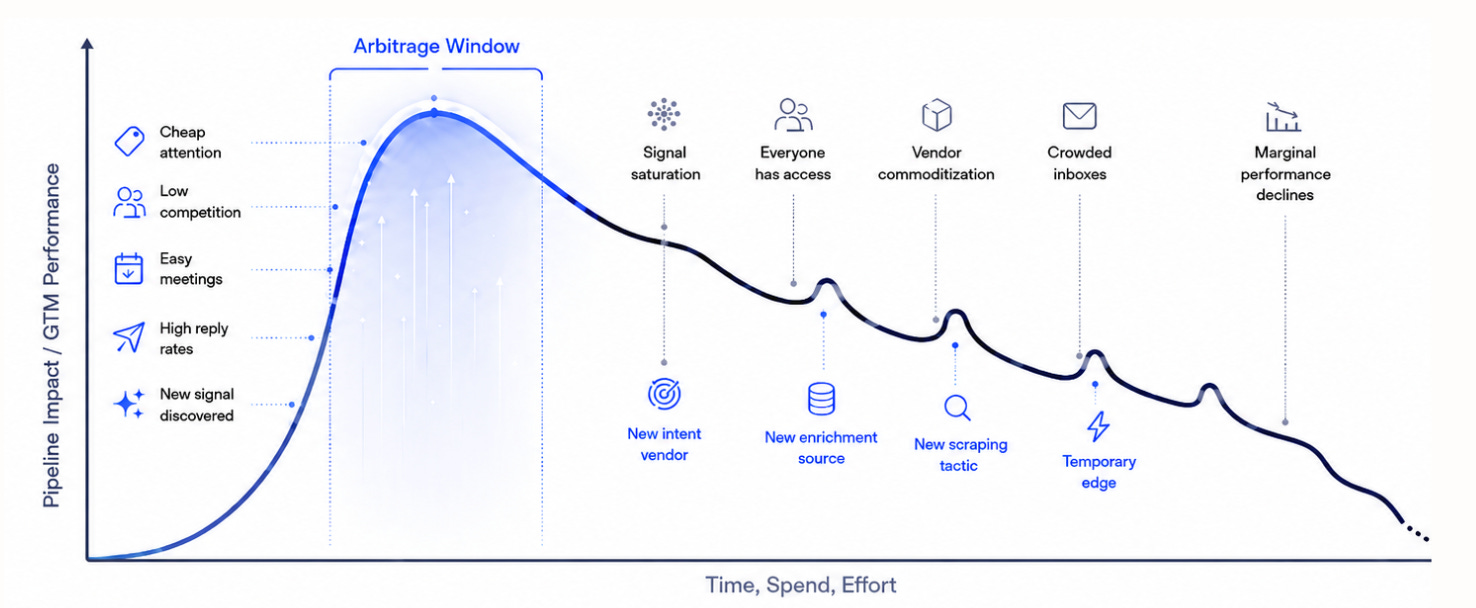
It’s a mistake to chase quick returns while neglecting your company’s own memory. The better approach is to use third-party signals while building a first-party signal warehouse in parallel.
The first-party signal moat
On the other hand, first-party signals come from direct interactions with your buyers. They include CRM notes, email replies, meeting transcripts, product activity, and the actions people take on your site or at your events.
They are not scraped.
They are not inferred.
They contain context your competitors do not have.
Most importantly, they compound.
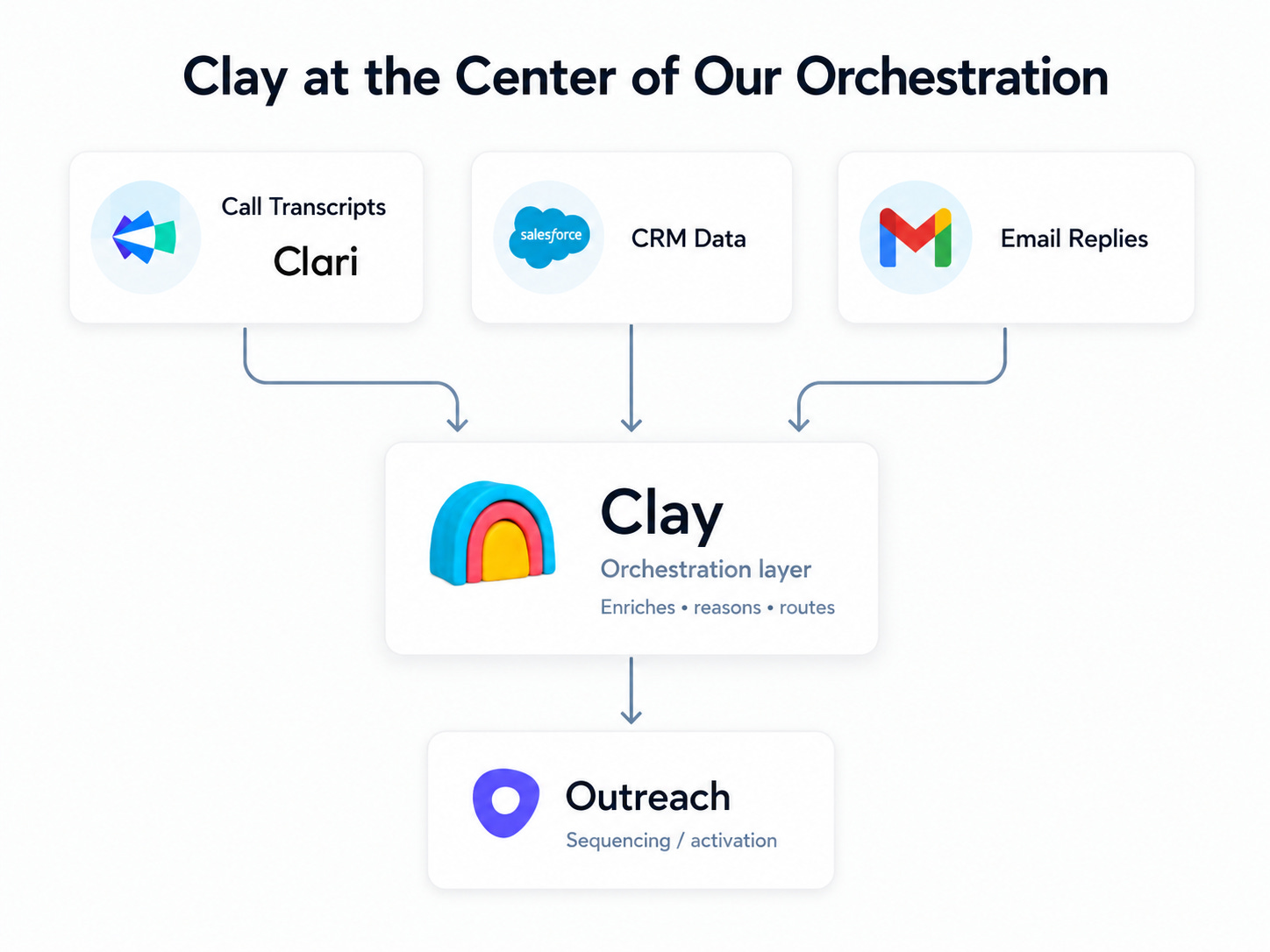
Verkada puts Clay at the center of this orchestration. That includes call transcripts from Clari, CRM data from Salesforce, and raw email replies flowing in. Clay enriches, reasons, and routes each lead to the right sequence in Outreach.
The compounding flywheel of first-party signals
The first-party curve climbs slowly at the start. A team’s earliest deposits are modest, a few CRM notes, then the email replies and meeting transcripts that pile up with every conversation. Product usage adds a richer layer on top, followed by behavioral context like the pages someone viewed or the events they joined.
Give it enough time, and those layers stack into something bigger, feeding competitive intelligence and eventually a full AI signal warehouse. Every interaction adds to the company’s organizational memory. Unlike a rented signal, that memory is proprietary. It also becomes more useful as the business learns how to structure it and connect it to follow-up plays.
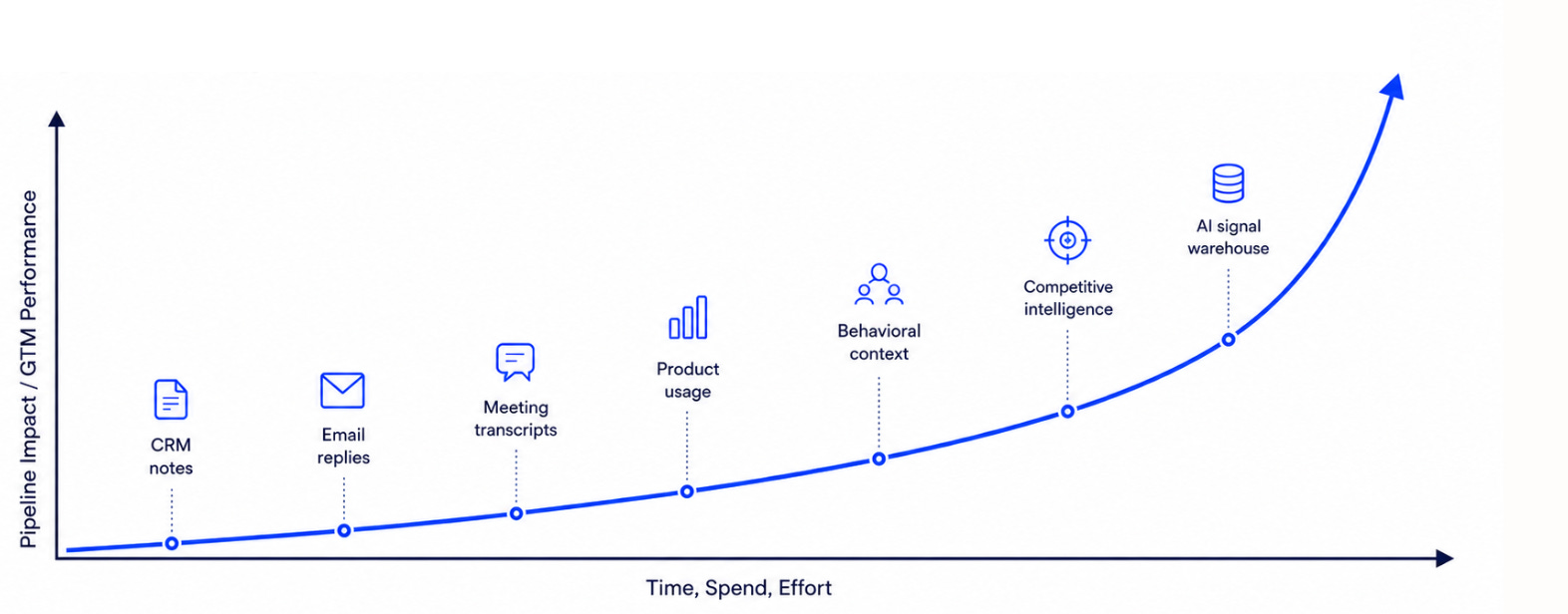
Plus, the impact grows over time.
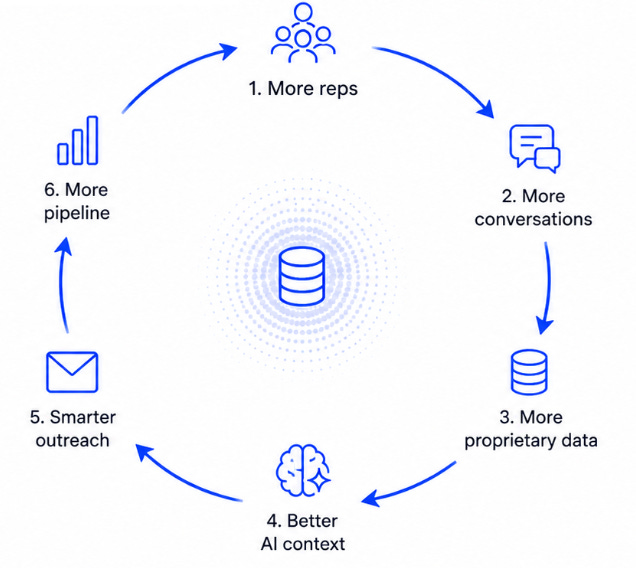
As your business grows, it feeds the flywheel. More reps on your team have more conversations, which produce more proprietary data. That data gives AI better context for timing and outreach. Smarter follow-up creates more pipeline, which helps the organization grow and starts the cycle again.
Third-party performance tends to peak and decline. A first-party system takes longer to build, but its value rises with every useful interaction the company retains. Overlaid on the third-party lifecycle, one line spikes and decays while the other keeps climbing.
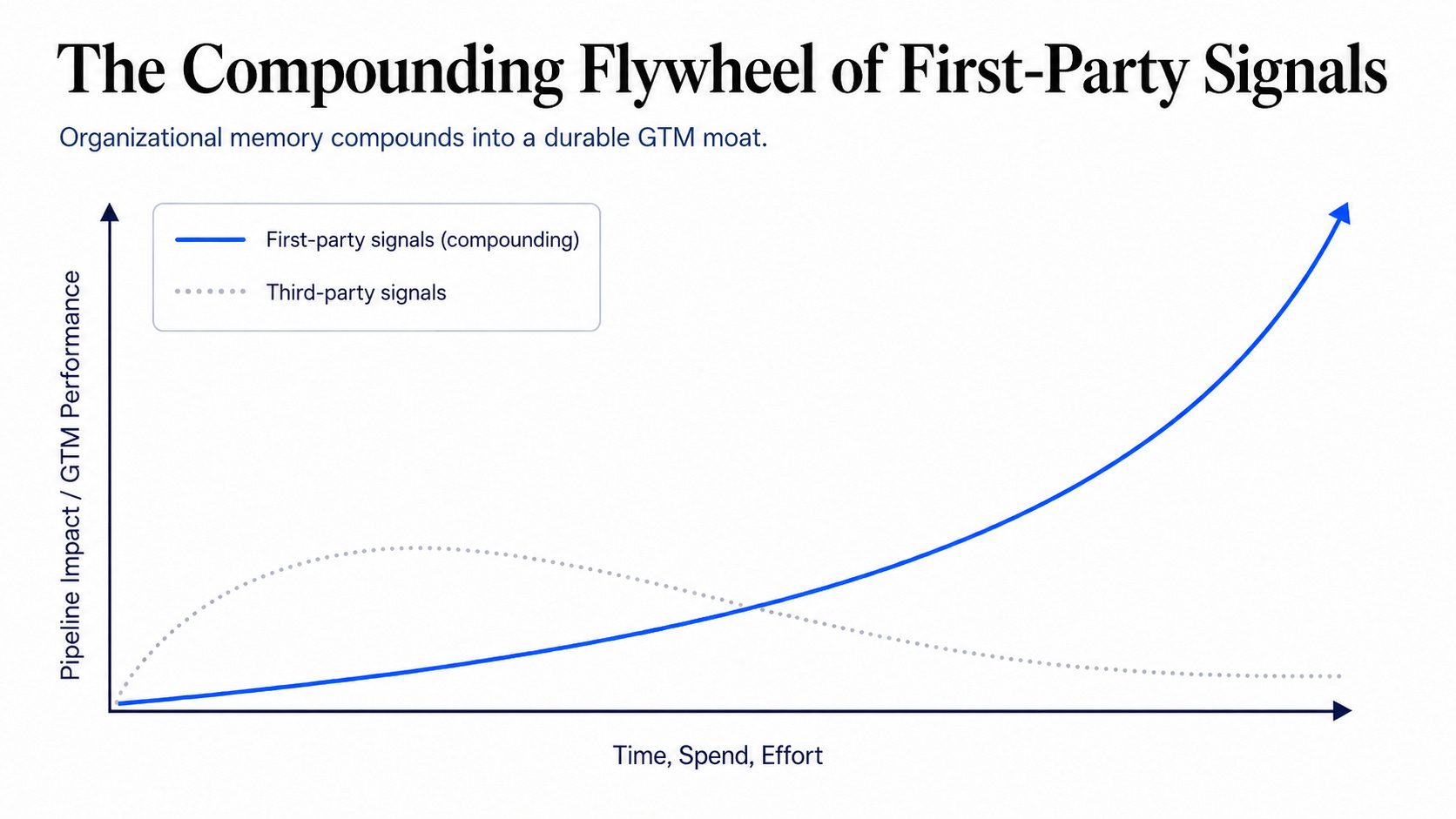
None of this means cutting rented signals out of the mix. They still earn their keep as a quick source of pipeline, but they can’t be the whole plan when every edge they offer has an expiry date.
Audience > Copy
When teams lack first-party signals, they polish copy to compensate; when they have them, there is far less to compensate for. The purpose of outbound is to be relevant enough to earn a reply. Great audience selection makes that easier because the message becomes obvious. Copy does not create intent; instead, it captures intent that audience selection has already found.
This matters as teams add AI to outbound. It’s easy to spend time asking AI for a clever opener or a reference to a funding round. Those details may help, but they do not answer the central question: why are you emailing this person in the first place?
Specificity means the recipient immediately understands:
Why are you emailing me?
Why now?
Why is this relevant to me?
Do it in as few words as possible and be almost boringly direct. If you think you need AI to write your email copy, your message and audience probably aren’t specific enough. This is why first-party signals work so well. The message doesn’t need to be clever. It needs to be relevant. The fix isn’t dropping AI; it’s constraining it.
Specific Clay workflows anyone can implement now
Clay can turn scattered first-party data into automations that a GTM team can inspect and control. The buyer context becomes structured fields and triggers that the rest of the GTM stack can act on.
Future reach out
This sequence has produced a 33% reply rate for Verkada, with just under half of those replies leading to demos. It starts with responses such as “get back to us in May” or “reach out next month.” These are valuable signals because the buyer did not say no. They supplied the timing and also gave you permission to follow up.
Before Clay, an SDR would add a task or log a status against the lead. Maybe. The account executive would leave a note in Salesforce. Maybe. Even when everyone did their part, six months would pass, the SDR moved teams, the account executive rolled off the account, and territories changed. The context ended up buried in a thread nobody will ever see.
Clay turns that unstructured data into a structured data layer:
Classification: Identify which email replies ask for future correspondence.
Reasoning: Determine when the follow-up should happen.
Structure the data: Put the result in a consolidated table and convert the raw reply from a string to HTML.
Sequence: Start outreach for each eligible prospect on the corresponding date.
From there, the email writes itself. Verkada uses the subject line “Checking Back In,” and the body copy notes you’re following up because they suggested it. Clay converts their original reply to HTML and drops it in at the bottom as a token, so the prospect sees their own words even when the outreach comes from a different rep in a fresh thread.
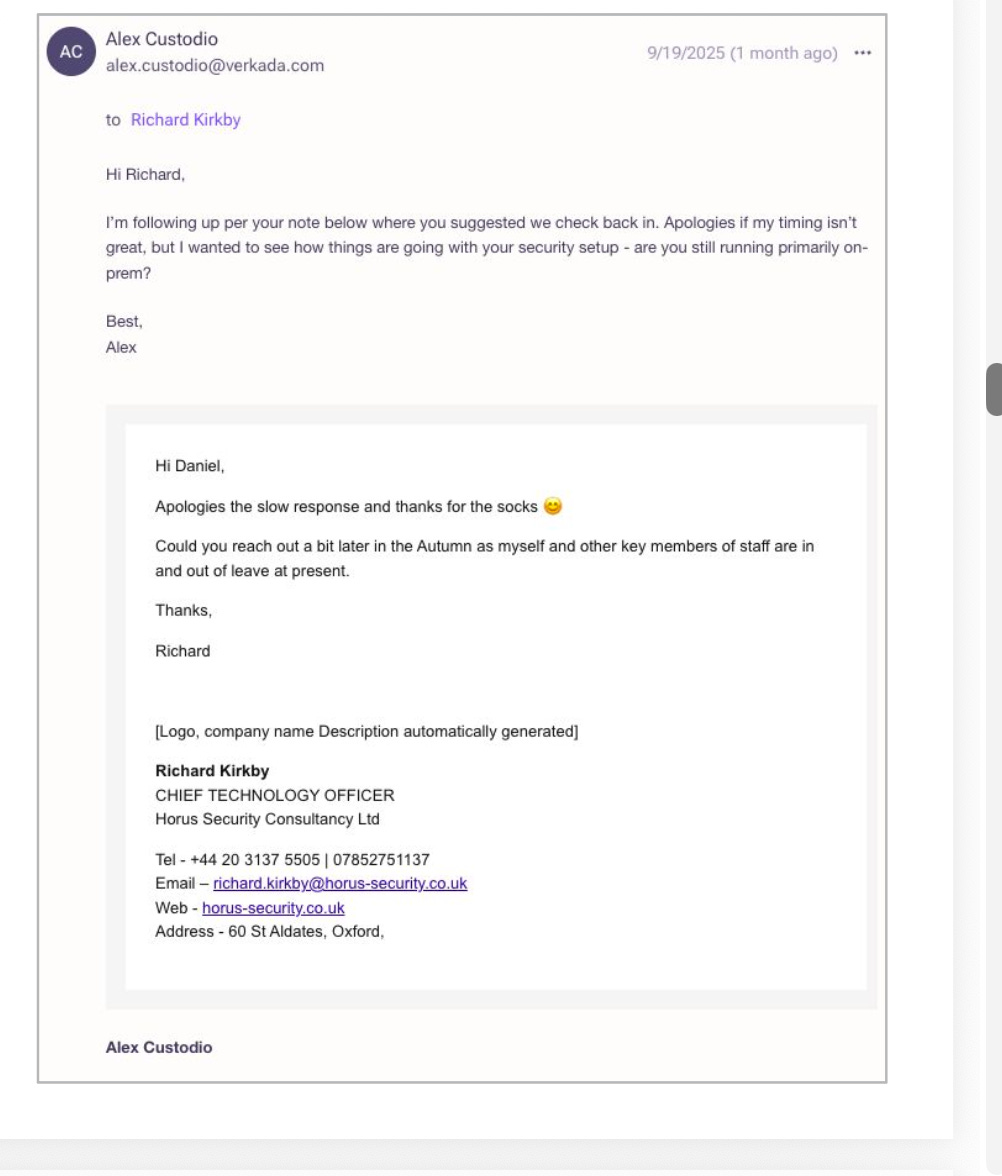
You’re emailing because they asked, and you’re emailing now because they named the timing themselves. It’s relevant because the earlier interaction was positive; it was just badly timed.
No longer at the company
Send enough outbound, and some of it will always bounce back with the same message: the person you emailed has left, and someone else now handles their work. Some teams treat these replies as dead ends. Really, they’re free enrichment because the business problem you were selling into didn’t leave with the contact, and the reply often names exactly who inherited it. Verkada uses Clay to turn this ordinary marketing byproduct into new pipeline and a cleaner CRM.
The workflow follows four steps:
Classification: Identify replies that say the contact is no longer at the company.
Reasoning: Check whether the reply names a new individual contact rather than a team alias.
Structure the data: Add the details to a consolidated table and update the CRM record.
Sequence: Send the replacement contact to the appropriate outreach sequence.
Here’s the email opener to use: “I was previously in touch with [former colleague], but they let me know they’ve moved on and pointed me your way.”
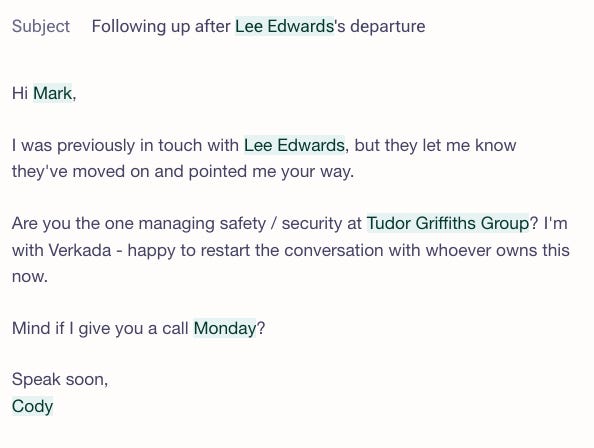
The recipient can immediately see why they are being contacted and why the timing makes sense.
Stale lead reactivation using Clay as a data layer and orchestration engine
Verkada also uses first-party signals to re-engage stale leads based on a specific action each person took. Before Clay, the demand generation team wrote custom SQL in BigQuery to define audiences and eligibility. It also coded SDR mailbox assignments and Outreach sequence IDs. Hightouch moved the results into Outreach, where follow-up happened.
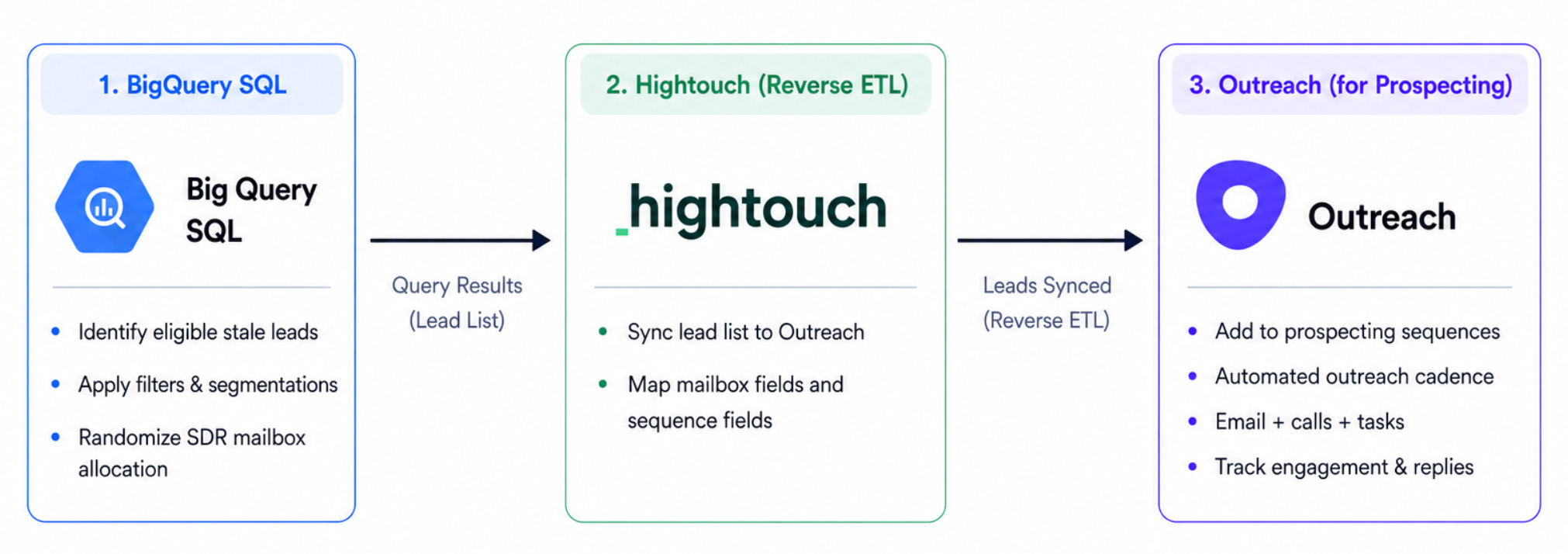
That setup created several problems:
Changes to SDR availability required SQL edits.
Every new audience idea required more SQL and risked breaking shared logic.
Troubleshooting meant working through SQL logs with poor visibility into eligible leads.
Adding enrichment or useful Salesforce context was difficult.
The new goal was a system simple enough to support rapid testing. Verkada began with past actions that could justify a later follow-up:
Attended a webinar
Missed a webinar
Attended a demo
Took a 30-day trial
Closed-lost deal
Attended an event
Downloaded an ebook
Watched an on-demand webinar
In Clay, each of those actions gets its own table. Webinar no-shows live in one, closed-lost deals in another, and every table pairs its audience with the one message written for it. Contacts who qualify for outreach then flow from those tables into a single master table, which acts as the control center. That’s where Clay adds any extra enrichment, checks that nobody has been emailed too recently, and spreads the leads evenly across the SDR team’s mailboxes. From there, the leads land in Outreach, which sends the emails and tracks the replies.
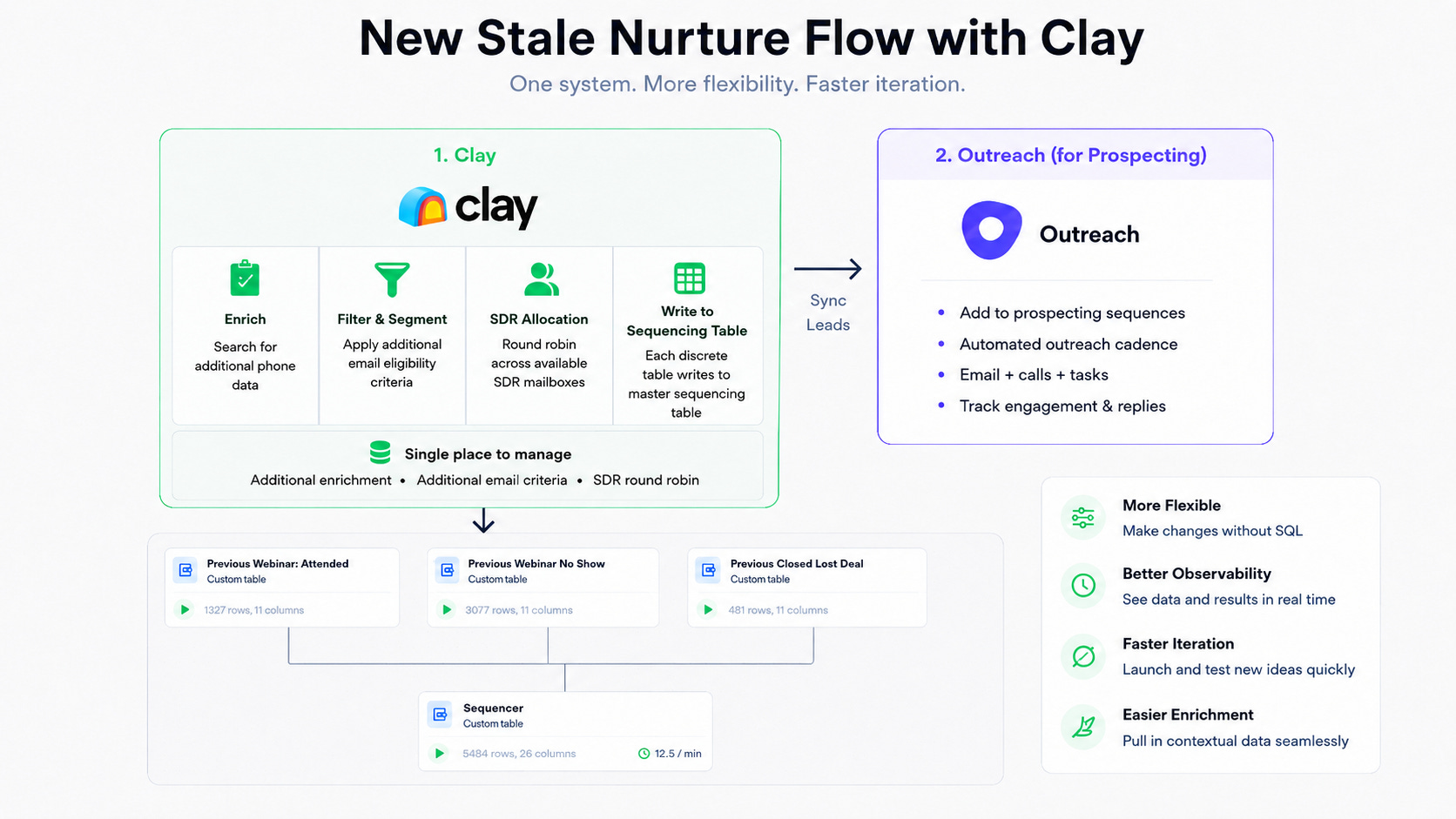
The benefits:
More flexible. Make changes to campaigns and audiences without SQL.
Better observability. See eligible leads and results in real time in Clay.
Faster iteration. Add an audience by adding a branch, and write to the master table only when it’s ready.
Easier enrichment. Pull in contextual data seamlessly, so the email references the specific webinar someone attended.
Every sequence follows the same rule: one signal, one message, one reason for reaching out.
The moat is already in your CRM
The most durable GTM advantage may already be sitting in old replies, CRM notes, and calls. Most teams already own that advantage but haven’t given it a shape their systems can act on.
As Leovic put it: “In the next 5 years, the best GTM teams won’t win by buying more intent data or having the most GTM tools. They’ll win by remembering what their buyers already told them.”
For more GTM tactics you won’t hear anywhere else, register for Clay’s upcoming livestreams. That’s where new episodes of How Clay Uses Clay drop, and where operators from companies like Verkada walk through the exact workflows behind their numbers.